Unbreakable Security for Your Digital Backbone
Protect your most critical data in transit between data centers, financial hubs, and cloud networks with quantum-safe encryption.
Protect your most critical data in transit between data centers, financial hubs, and cloud networks with quantum-safe encryption.
Qdit Labs offers two complementary QKD protocols optimized for different business deployment scenarios, both providing mathematically proven security against all computational attacks.
Coherent-One-Way QKD uses weak coherent pulses with time-bin encoding to detect eavesdropping. It's ideal for enterprises needing a balance of simplicity and high performance for metro-scale networks.
Differential-Phase-Shift QKD encodes information in the relative phase between consecutive photon pulses, offering higher key-generation rates for long-haul fiber networks and high-throughput data.
| Feature | COW QKD | DPS QKD |
|---|---|---|
| Protocol | Coherent-One-Way | Differential-Phase-Shift |
| Encoding Method | Time-bin encoding | Phase difference encoding |
| Key Rate (at 22dB loss) | ~1 kbps | ~2 kbps |
| Max Distance | >100 km | >100 km |
| Eavesdrop Detection | Monitoring line statistics | Phase correlation analysis |
| Best For | Metro networks, moderate distances | Long-haul, high-throughput links |
The science behind our unbreakable quantum encryption
Unlike classical encryption that relies on computational complexity, QKD's security is guaranteed by the fundamental laws of quantum physics. Any attempt to measure quantum states disturbs them (Heisenberg Uncertainty Principle), making eavesdropping instantly detectable.
Quantum Uncertainty
Measuring a quantum state changes it, allowing legitimate users to detect potential eavesdropping attempts.
No-Cloning Theorem
Quantum states cannot be perfectly copied, preventing undetected interception
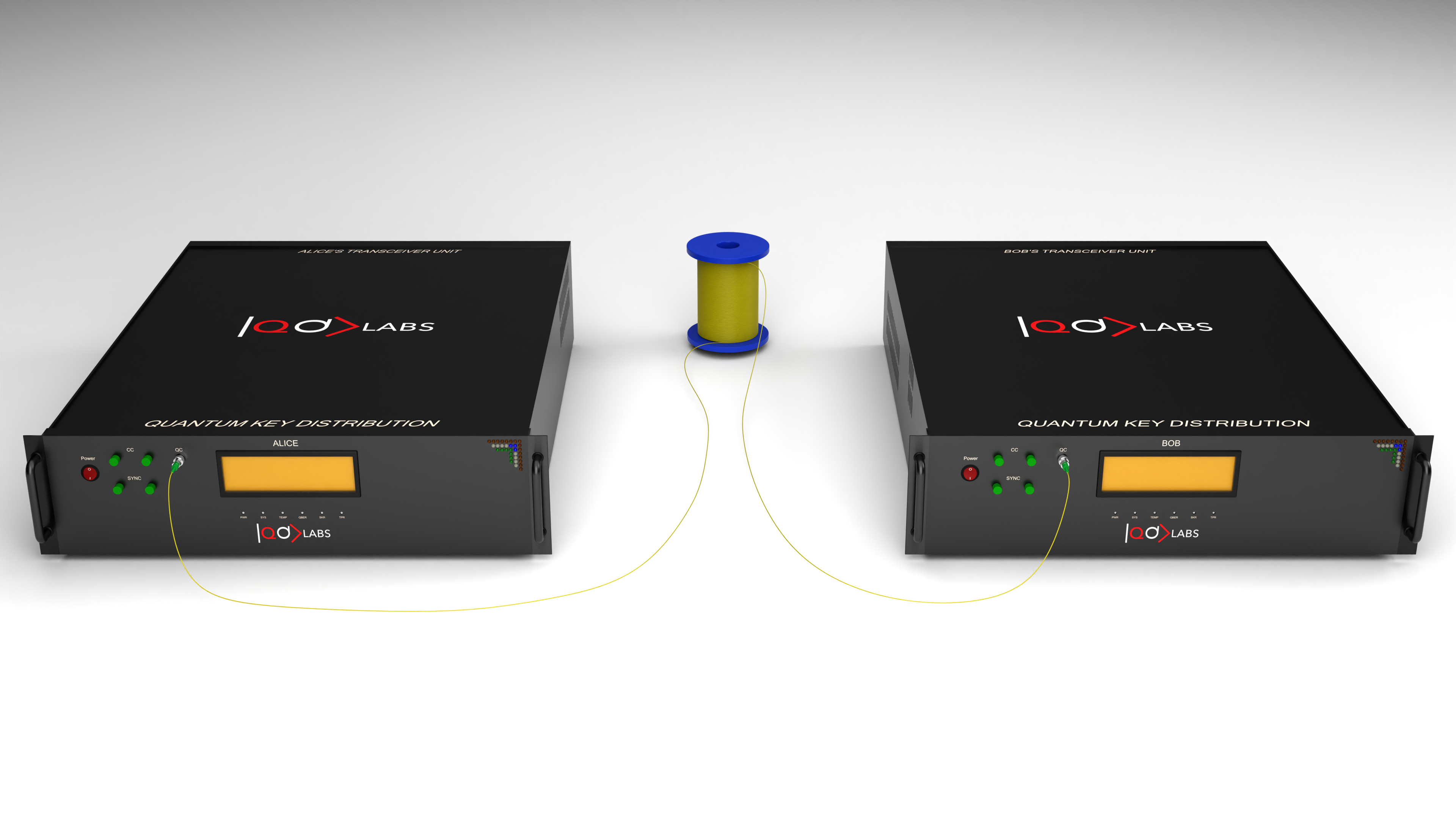
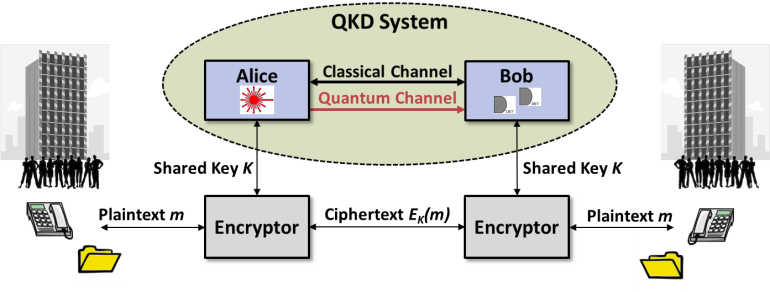
Alice encodes random bits in quantum states (photons) and sends them to Bob through an optical fiber.
Bob measures the incoming quantum states, then both parties reconcile detected measurements to form a raw key.
Parties compare a subset of their keys to detect any quantum bit error rate (QBER) and confirm no eavesdropping occurred.
Advanced error correction and privacy amplification algorithms are applied to produce a final, perfectly secure key.
Flexible integration options for your security infrastructure
Secure links between data centers with rack-mounted QKD terminals and key management systems.
Point-to-point quantum-secured links for metropolitan area networks and financial exchanges.
Trusted node networks for national-scale quantum-secured communication infrastructure for a country's digital backbone.
Contact our quantum security experts to discuss how Qdit solutions can protect your organization against emerging threats.